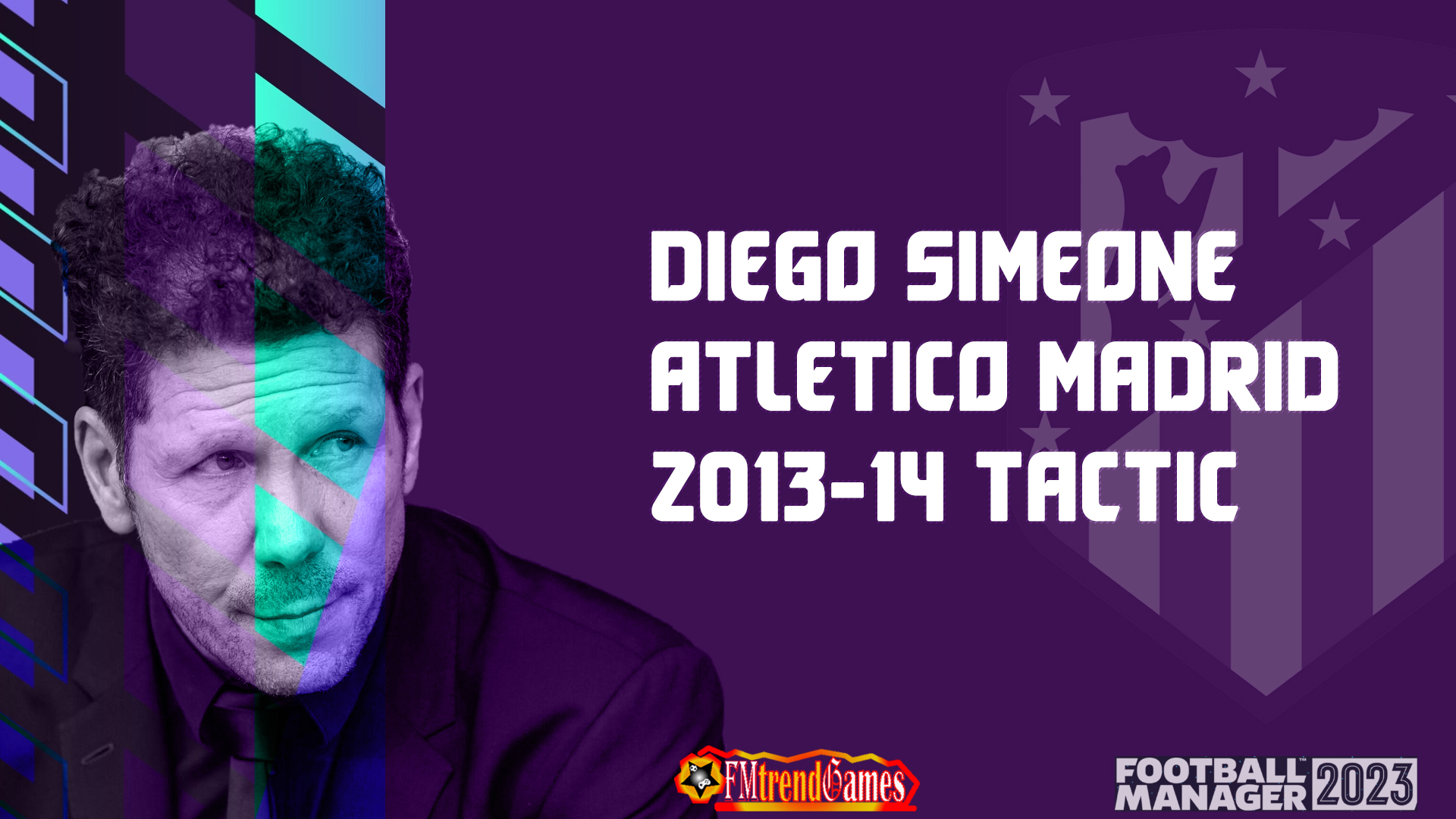
Diego Simeone Best Tactic with 2013-14 Atletico Madrid

Diego Simeone Best Tactic with 2013-14 Atletico Madrid | FM23

Spread the love

In the post, I will be talking about another legendary tactic under my FM23 legendary tactics, and that is Diego Simeone best tactic with the 2013-2014 Atletico Madrid team.

Having won the Copa del Rey in 2012/2013, the 2013/2014 season was Diego Simeone’s third season and also his second full season as Atl. Madrid head coach. In the summer transfer windows, they sold their top striker, Radamel Falcao to Monaco but were able to sign David Villa on a free transfer from Barcelona – Villa was pivotal in their success that season. At the end of the season, the Indios won the Laliga title for the first time since the 1995/1996 season and Simeone was part of that team as a player. They also came close to winning the 2013/2014 Uefa Champions League but they were defeated by Ancelotti’s Real Madrid.

I can say that 2013/2014 Atletico Madrid was Simeone’s best Atletico team ever because they were runner-ups at the Uefa Champions League in the same season too. With that being pointed out, let’s get into the details of this tactic that I created with Fiorentina in FM23, shall we?

Diego Simeone Best Tactic | Tactical Instructions

[ihc-hide-content ihc_mb_type=”show” ihc_mb_who=”1,3,4,5,6″ ihc_mb_template=”1″ ]

In Possession

Playing out of defence was not that popular back in the 2013/2014 season, Simeone’s team implemented the direct approach. When the goalkeeper took direct kicks, he mostly directed them to the position of their target forward, Diego Costa who had the physicality to win aerial duels and bring the team into play.

As they progressed with the ball, Atletico Madrid’s men focused their plays through the middle or through the sides of the pitch. They used standard passing directness and passed the ball into an open space. Lastly, their ball movements were at the highest tempos, plus they ran at the opposition defenders more often than looking for a passing option first.

In Transition

Their attacking width was very narrow. Counterattacks were the team’s deadly weapons and there could be fluid or direct counterattacks. As they approach the final third, The Indios used overlaps on both sides of the field. Finally, they would shoot on sight hit early crosses or worked their way into the box.

When the team lost the ball, they would regroup to their own half rather than counter-pressing. When the goalkeeper, Courtois caught the ball, he would distribute the ball by taking long kicks to the position of the target forward, Diego Costa.

Out Of Possession

Simeone’s men’s defensive shape was mainly 4-4-2. They equally defended with a trap outside pressing trap to force the opponents outside at wide areas, plus they did get stuck in during tackles.

Simeone employed a mid-block line of engagement to always keep their opponent’s in their own half and when the opponent got into Atl. Madrid’s half, they pressed them with the highest pressing intensity. Their defensive line was at standard. In addition, the defenders could step up the defensive line which means they moved above to close down attackers in unity, leaving them little room to play or drop off the defensive line to defend closer to their own goal.

Diego Simeone Best Tactic | Formation Lineup

The Fiorentina players that I chose for the roles of the then-ATM players

  • Terracciano – Courtois
  • Igor – Miranda
  • Milenkovic – Diego Godin
  • Biraghi – Filipe Luis
  • Dodo – Juanfran
  • Duncan – Tiago
  • Amrabat – Gabi
  • Nico Gonzalez – Arda Turan
  • Sottil – Koke
  • Saponara – David Villa
  • Cabral – Diego Costa

Diego Simeone Best Tactic | Role Selections

GK

Courtois was a sweeper keeper on defence duty.

CDs

Diego Godin and Joao Miranda were traditional central defenders on defence duties. They were cautious of the passes they take and would also sit within the defensive line to break up attacks, marking opposition attackers and then preventing the ball from getting into the box.

FBs

Filipe Luis and Juanfran were wing-backs on support duties. They would stay wide during attacks, looking to run at the defenders and cross the ball into the box. The two were equally tracking back and protecting the defensive line.

CMs

Tiago and Gabi were ball-winning midfielders, one on support duty and the other on defence duty.

Their objectives were to close down opponents and win the ball. They had some comfort with the ball which was why they could pick out creative teammates after winning the ball. The one on support duty would get forward to support the attacks which the two took turns in doing.

Side Midfielders

Arda Turan was a wide playmaker on attack duty. He would sit narrow during attacks and cut inside with the ball. Turan was the team’s main source of creativity, he always looked for space to play killer ball or create great chances.

Koke was a wide midfielder on support duty. Just like other wide midfielders, He could move to midfield as an extra midfielder or sometimes stay wide at the flank to play through balls or cross the ball from there. Koke was creative which was why he took risky passes and had the green light to shoot more often.

CFs

Diego Costa was a target forward on attack duty. He had the physical strength to bully the defenders, held onto the ball and offered a flick on or played simple passes to onrushing teammates. Costa didn’t drop more often to the midfield rather he stayed higher up the pitch, leading the attacking lines.

David Villa was a deep-lying forward on support duty. He would drop to the midfield to act as a playmaker, bringing teammates into play before getting forward to attack the box.

Team Mentality

At Home, a positive mentality works better for lower, average teams but an attacking mentality works better for tougher teams.

On Away, a balanced mentality works best against all teams.

Result and Stats

Data Hub

Scoring

Conceding

DOWNLOAD

[/ihc-hide-content]

You can follow us on Twitter @fmtrendgames
Similar Posts

3 Comments

Leave a Reply